Atacama Salar Formations
Stretching across northern Chile between the Cordillera de la Costa and the high Andes, the Salar de Atacama represents the world's most enduring hyper-arid evaporite basin.
Atmospheric Desiccation
The hyper-aridity of the Atacama Basin is caused by a double rain-shadow barrier. To the east, the towering Andes block moist tropical air masses originating from the Amazon basin. To the west, the cold Humboldt Current flows north along the Chilean coastline, chilling the lower troposphere. This causes a persistent marine temperature inversion that prevents clouds from rising to form rain.
As a result, some interior sectors of the Atacama haven't seen significant precipitation in centuries. With evaporation rates outstripping rainfall by more than 250 to 1, all water entering the closed endorheic basin evaporates, leaving behind dissolved mineral solutes.
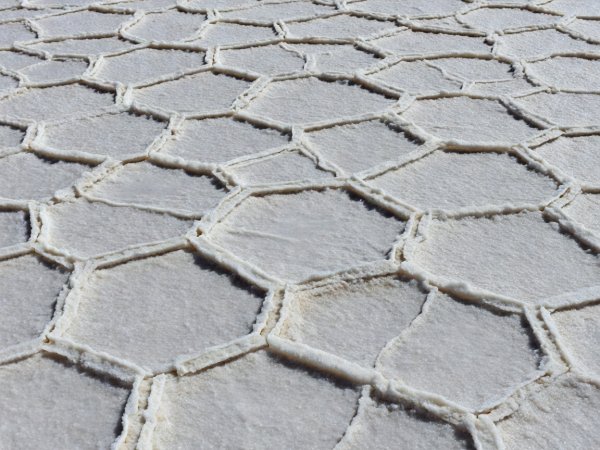
Polygonal Halite Ridging
The iconic hexagonal and pentagonal crust patterns of the Salar de Atacama are driven by cyclic thermal expansion. During intense daylight, desert surface temperatures rise above 45°C, expanding the halite crust. At night, high elevation drops temperatures near freezing.
As mineral brine rises through capillary action and dries, fresh salt crystals grow within the existing crust fissures. This mineral growth forces adjacent salt plates against one another, buckling the edges upward into jagged ridges up to half a meter high. This produces a rough terrain that resists wind erosion and traps airborne dust over millennia.
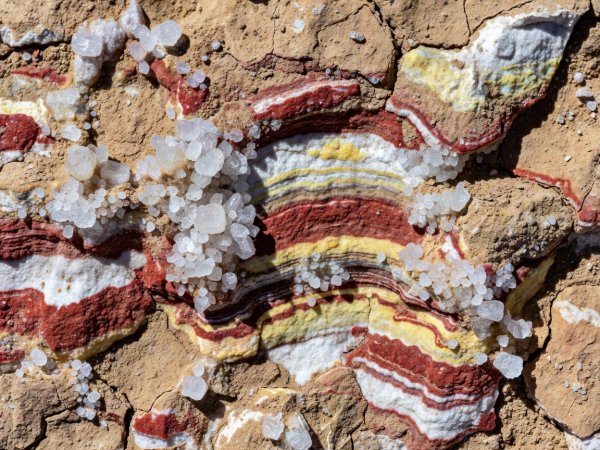
Chemical Stratification of the Salar Evaporites
As saline waters drain toward the center of the Atacama Basin, minerals precipitate out in order of solubility, forming concentric rings across the desert floor:
| Zonal Belt | Dominant Mineral | Chemical Formula | Solubility Index |
|---|---|---|---|
| Outer Rim | Calcite / Calcium Carbonate | CaCO3 | Lowest – First to precipitate upon basin entry |
| Intermediate Ring | Gypsum / Anhydrite | CaSO4 · 2H2O | Moderate – Precipitates as water volume contracts |
| Central Core | Halite (Rock Salt) | NaCl | High – Forms the thick polygonal surface crust |
| Deep Interstitial Brine | Lithium, Potassium, Borates | LiCl, KCl, B4O7 | Extremely high – Remains dissolved in residual brine pockets |
This concentrated chemistry makes the Atacama Basin both an important reservoir for lithium and boron and an essential testing site for planetary landers seeking biosignatures in hyper-dry soils like those on Mars.