Danakil Depression Salts
Descending more than 125 meters below global sea level in northern Ethiopia, the Danakil Depression embodies one of the most mechanically violent and chemically extreme geological systems on continental crust.
The Afar Triple Junction Rifting
The Danakil Depression is not merely a desert sinkhole; it is an emerging ocean basin in its embryonic stages. The crust beneath the Afar region is being pulled apart in three directions simultaneously by the divergence of the Nubian, Somali, and Arabian plates. This pulling has thinned the continental lithosphere to less than 15 kilometers in thickness, allowing hot basaltic magma to rise near the surface.
Because the Red Sea has repeatedly flooded and evaporated across this sinking rift valley over the past several million years, an evaporite layer over two kilometers thick has accumulated. Magma intrusions beneath Dallol heat this trapped salt deposit, forcing hyper-saline, mineralized brines upward through vents and fissure chimneys.
The Dallol Mineral Palette
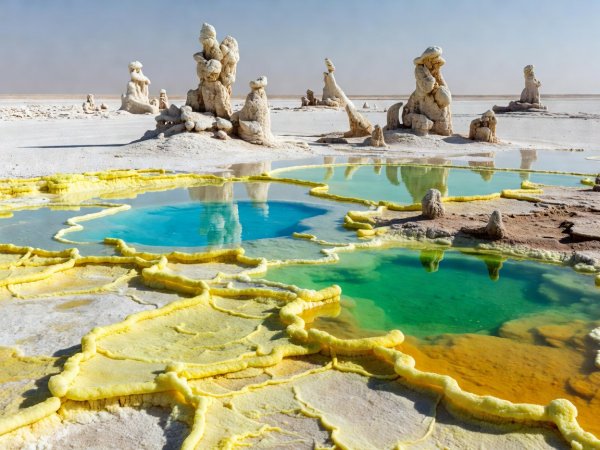
The striking chromatic spectrum of the Dallol crater—fluorescent yellows, emerald greens, and deep ochre rusts—is produced entirely by inorganic geochemical precipitation. As 108°C groundwater rich in iron, magnesium, sulfur, and chlorine reaches atmospheric contact, rapid oxidation takes place.
Ferrous iron oxidizes into ferric iron, shifting liquid color from olive green to deep amber. Pure elemental sulfur precipitates around vent mouths to construct fragile hollow pillars. As vapors cool, halite (rock salt) crystals coalesce on the water's surface in micro-crust rafts before collapsing into dense terraced shelves.
Danakil Geochemical & Climatological Profile
Field measurements compiled from geological surveys across the Afar rift indicate an environment at the outer threshold of biological tolerance:
| Parameter | Measured Range | Geochemical Cause |
|---|---|---|
| Surface Water pH | 0.0 to 1.5 | Extreme concentration of sulfuric and hydrochloric gases |
| Hydrothermal Vents | 100°C – 110°C | Magmatic sill proximity at shallow 2km depth |
| Evaporite Bed Depth | 1,500m – 2,200m | Repeated marine transgressions from prehistoric Red Sea |
| Mean Annual Ambient Temp | 34.5°C (Max > 50°C) | Sub-sea depression topography trapping convective thermal cells |
Understanding the Danakil basin provides geophysicists with a rare opportunity to observe the mechanics of continental breakup and the early depositional phases of an ocean basin before marine waters permanently submerge the rift floor.