The Cave of Crystals
Buried 300 meters beneath the Sierra de Naica in Chihuahua, Mexico, the Cueva de los Cristales contains some of the largest natural mineral monoliths discovered in the crust.
The Mechanism of Selenite Gigantism
The massive selenite pillars of Naica—spanning up to 11.4 meters in length, 1 meter in diameter, and weighing over 50 tons—are pure hydrous calcium sulfate (CaSO4·2H2O). The formation of these colossal structures required a balance of heat, chemistry, and geological time.
Around 26 million years ago, a magma intrusion forced mineralized thermal solutions through fault lines in the surrounding limestone. The water was rich in anhydrite, the anhydrous form of calcium sulfate. At temperatures above 58°C, anhydrite dissolves smoothly in hot water. However, as the magma slowly cooled over millennia, the cave water temperature cooled to roughly 54°C.
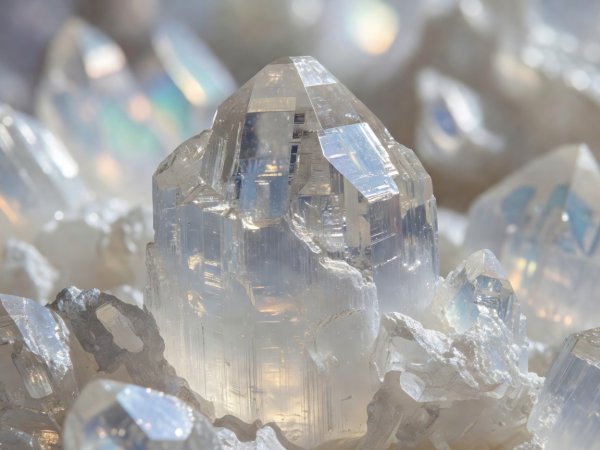
500,000 Years of Slow Crystallization
Below 58°C, anhydrite becomes unstable in aqueous solution, while gypsum (selenite) precipitates out. Critically, because the cavern was completely sealed with no direct air access, the temperature decline was incredibly gradual, dropping less than one degree every several thousand years.
This slow change meant the solution never reached the high supersaturation needed to spark thousands of new, tiny seed crystals. Instead, calcium and sulfate ions continuously attached to a few existing crystal faces. Crystallographic analysis indicates that these giant beams grew at a rate equivalent to the thickness of a postage stamp every century, taking over 500,000 years to reach their full size.
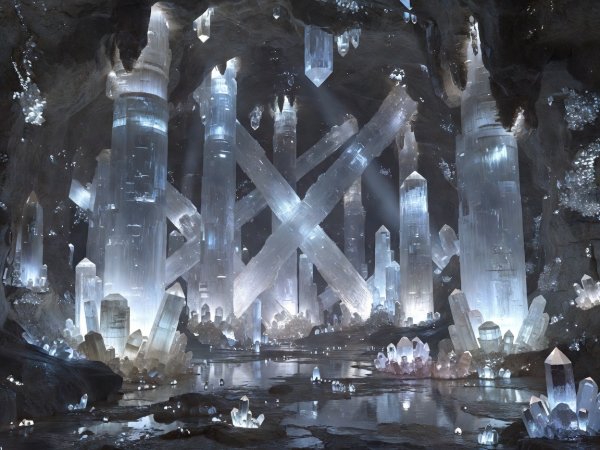
Environmental Conditions of the Naica Vault
Before industrial pumps drained the mine to extract lead and silver, the cave was submerged in mineral water. Once drained, it exposed an environment dangerous to unprotected human physiology:
| Physical Parameter | Vault Value | Physiological Impact |
|---|---|---|
| Air Temperature | 58°C (136°F) | Rapid hyperthermia within 10 minutes without cooling gear |
| Relative Humidity | 90% to 99% | Prevents evaporative sweating, accelerating internal heat buildup |
| Crystal Composition | CaSO4 · 2H2O | Monoclinic crystal system, Mohs hardness 2 (easily scratched by fingernail) |
| Structural Depth | 290m – 310m Below Surface | Protected from surface seasonal shifts, ensuring thermal consistency |
With the cessation of mining drainage in recent years, groundwater levels have gradually returned to re-submerge the crystals. This natural reflooding restores the water buoyancy that supports these multi-ton beams and protects them from air dehydration.